
Selling Where Addresses Don’t Exist
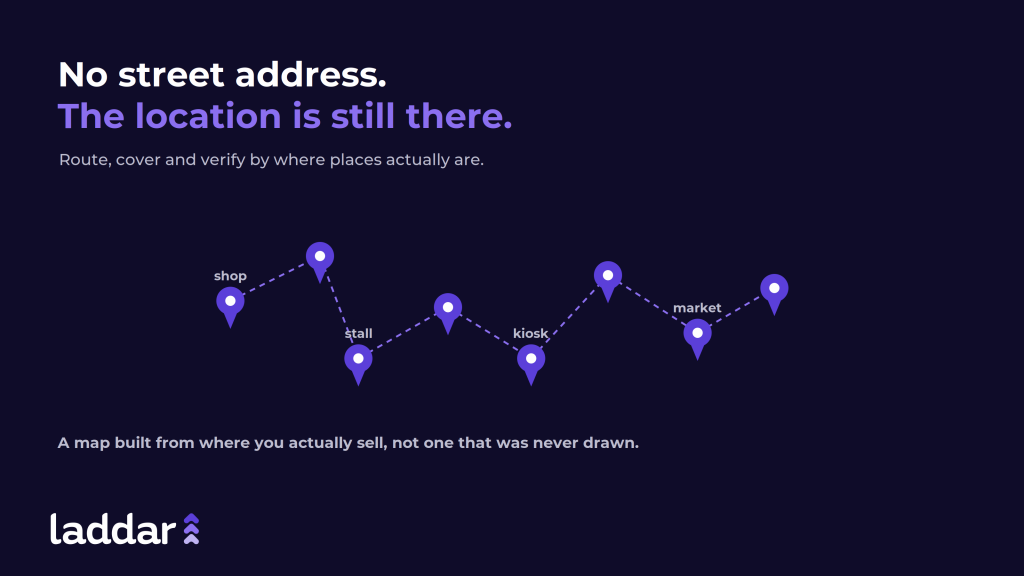
A great deal of software for managing field sales quietly assumes something that is simply not true across much of Africa: that every customer has a formal street address. Routing tools plan journeys between addresses. Coverage is tracked by address. Visits are logged against an address. The whole model rests on a map that, in many of the markets where African businesses actually sell, was never fully drawn.
The shop in the market, the stall on the corner, the customer down an unnamed street, these are real, valuable, and have no address a mapping tool would recognise. Selling to them is not a problem to be apologised for; it is a large part of where the business is. The real question is how to route, cover and verify a field operation in a world where the formal address does not exist. It turns out the answer is better than the address-based model it replaces.
The address was always a proxy
Here is the useful starting insight: in formal markets, the address was never what anyone actually cared about. It was a proxy, a convenient stand-in for the thing that mattered, which is the physical location. You used an address because it was the easiest way to refer to a place.
In markets where addresses are incomplete, you lose the proxy, but you do not lose the thing it pointed to. The location is still there; the shop still sits exactly where it sits. So the move is not to force addresses onto a place that has none, but to work directly with the location itself, which is the real object all along. Done right, this is more precise than an address, not less.
Route by location, not by address
A field operation does not actually need addresses to route agents. It needs to know where places are and to plan efficient movement between them, and that is a matter of location, which can be captured directly.
When a customer’s location is recorded as a point on the ground, by the agent who visited, rather than as a formal address, you can build your map from your own activity. Over time, the operation accumulates a map of exactly the places it sells to, pinpointed where they truly are, including every shop and stall no official map ever listed. You route between these points, and the routing is based on reality rather than on an address database that omits half your customers.
This is not a workaround. A map built from your own verified locations is often better for your purposes than a formal one, because it contains precisely the places you care about and nothing you do not.
Confirm coverage by where agents actually went
The same shift fixes coverage. In an address-based model, coverage is a question of which addresses were visited, which breaks immediately when customers have no addresses. In a location-based model, coverage is a question of where agents actually went, which you can see directly.
When agent movement and visits are captured as locations, you can see which areas were genuinely covered and which were missed, not against a list of addresses, but against the real ground. You know a market was worked because you can see the agent was there, at the place, not because a box was ticked against an address that may not describe anywhere.
Verify visits by presence, not by paperwork
Address-less selling also solves a verification problem that addresses never really handled anyway. How do you know a visit happened? In many operations, the answer was a logged entry against an address, which proves nothing about whether anyone actually went.
Capturing visits by location and time, confirming the agent was physically at the place when they said, verifies the visit far more reliably than any address-based record. The absence of a formal address does not weaken verification; location-based confirmation is stronger than the paperwork it replaces, because it attests to presence on the ground rather than to a form being filled in.
Built for the ground, not the map
The deeper point is that a field operation should be built around the ground truth of where selling happens, not around a formal map that assumes conditions many African markets do not have. Software that needs addresses is quietly software built for somewhere else, and forcing your reality into its assumptions is where friction and lost coverage come from.
This is why Laddar Field OS captures activity by location, works offline where there is no signal to check a map against anyway, and verifies visits by presence on the ground, because it was designed for markets where the formal address is the exception, not the rule. But the reframe matters whatever you use. The absence of addresses is not a gap to be worked around. It is a reason to build on location directly, which is the more accurate foundation your operation needed all along.
FAQ
How do you run field sales where customers have no formal addresses? By working with location directly rather than addresses. Capture where each customer actually is as a point on the ground, build your map from your own verified activity, and route, cover and verify against real locations rather than an address database that omits many of your customers.
Isn’t selling without addresses harder to manage? It can be more accurate, not less. The address was always just a proxy for a physical location; working with the location directly gives you a map of exactly the places you sell to, more precise coverage, and stronger visit verification than address-based paperwork ever provided.
How do you verify a visit happened if there is no address? By capturing the visit as a location and time, confirming the agent was physically at the place when they said. This attests to presence on the ground, which is far more reliable than a logged entry against an address, with or without a formal address existing.