Connecting customer conversations to action
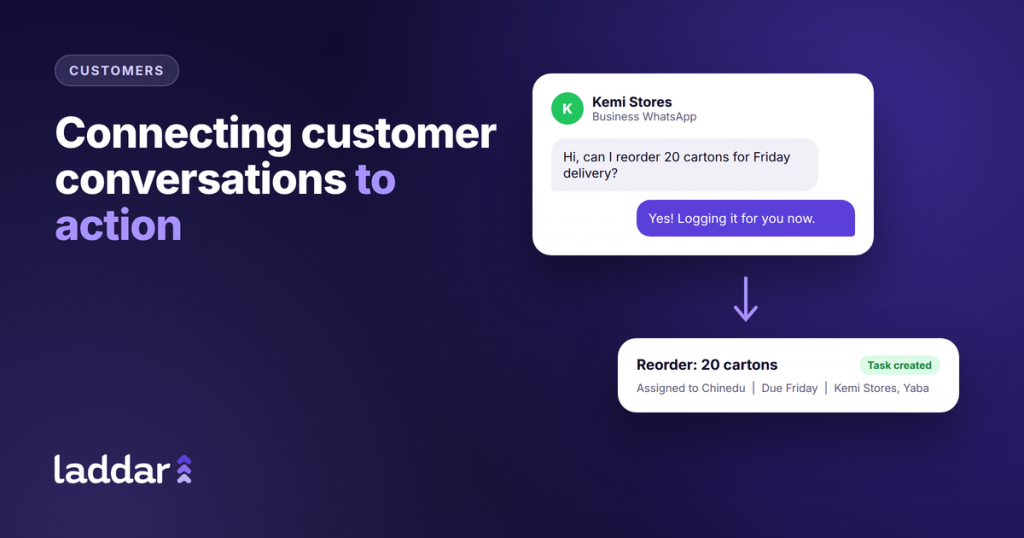
Your customers are talking to your business all the time. They send WhatsApp messages, call your sales line, speak to agents in the field and reply to follow-ups. Each conversation holds something useful: a request, a complaint, a reorder, a referral or a warning that they are about to leave.
The question is what happens next.
The gap between talking and doing
In many businesses, customer conversations live in scattered places. Messages sit in personal WhatsApp accounts. Calls happen on agents’ own phones. Notes from field visits stay in notebooks or memory. Even when someone takes action, nobody else can see it.
This creates familiar problems:
- A customer explains an issue twice because the second person has no context.
- A reorder request is missed because the agent who received it was off that day.
- A manager cannot tell whether complaints are rising until the end of the month.
- When an agent leaves, their customer relationships and history leave with them.
The conversation happened. The action did not.
Why communication belongs close to operations
Customer communication is most valuable when the people who can act on it can see it. A sales rep should know a retailer complained yesterday before walking into the shop today. A support lead should see that ten customers asked about the same delivery delay. A manager should be able to review how a key account was handled.
When communication sits next to the work, conversations turn into tasks, visits, orders and fixes, instead of disappearing into individual inboxes.
What connected customer communication looks like
Business-owned channels. Customers reach the business, not an individual. Business WhatsApp numbers and business phone lines keep conversations and history with the company, even when staff change.
One shared customer record. Messages, calls and field visits link to the same customer, so anyone picking up the relationship sees the full story.
Clear ownership and routing. Each conversation reaches the right team or person, and it is clear who is responsible for the next step.
Visibility for managers. Leaders can see volumes, response times and common themes without asking for manual reports.
How Laddar connects the pieces
Laddar brings customer communication into the same connected platform as the rest of your operation. Laddar Conversations supports WhatsApp communication with customers. Laddar Voice provides business lines, routing, recordings and call history that belong to the business. Field OS links customer records to the visits, orders and activities your field teams complete.
Together, they make it easier to move from “a customer said something” to “the right person did something about it.”
The bottom line
Customer conversations are only as valuable as the action they lead to. Bringing communication closer to the teams and processes that act on it means fewer dropped requests, better customer experiences and relationships that stay with your business.
Want to connect your customer conversations to your operations? Send an email to getstarted@laddar.africa