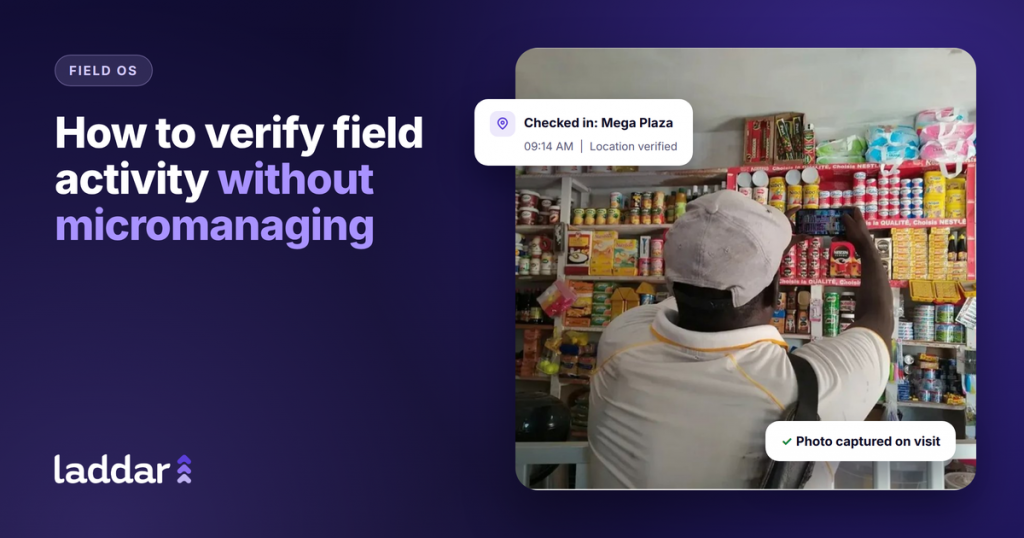
How to verify field activity without micromanaging
“Where are you now?” “Did you visit that outlet?” “Send me a picture.”
For many field managers, the day is a stream of calls and messages like these. It is exhausting for managers, frustrating for agents and still not very reliable. A phone call tells you what an agent says happened, not what actually did.
There is a better way to build trust in field activity: let the work verify itself.
Why micromanaging fails
Constant check-ins feel like control, but they come at a cost:
- Managers lose hours chasing updates instead of coaching or solving problems.
- Agents lose time answering calls when they should be selling or serving customers.
- Trust erodes on both sides. Good agents feel watched; weaker ones learn what to say.
- The data stays poor. Verbal updates are hard to compare, total or audit.
The goal is not more supervision. It is better evidence, captured automatically as agents work.
What verifiable field activity looks like
Geotagged check-ins and check-outs. When agents check in at a location, the app records where and when. Check-outs show how long they stayed. Managers can see visits happened without asking.
Geofencing for assigned locations. Defining the area around an outlet, site or territory makes it clear when check-ins happen in the right place.
Photo evidence with context. Photos taken inside the app carry a time and location, so a picture of a shelf or display is tied to a real visit, not pulled from a gallery.
Structured forms instead of free text. Standard questions for audits, surveys and orders produce clean data that can be compared across agents and locations.
Attendance with verification. Digital check-in for shifts, including biometric verification where it is needed, confirms the right person showed up at the right place.
Managing by exception
Once activity verifies itself, the manager’s role changes. Instead of checking on everyone, they focus on exceptions:
- an agent who has not checked in by mid-morning
- an outlet that was skipped for two weeks
- a visit that lasted two minutes when it should take twenty
- a territory where orders dropped sharply
This is a far better use of a manager’s time. Agents doing good work are left to get on with it, and support goes where it is actually needed.
Making the shift with your team
Introducing verification works best when it is framed as fairness, not surveillance. Explain that clean data protects good agents: it shows their work clearly and supports fair incentives and commissions. Start with the basics, such as check-ins, a few key forms and photo evidence, then add more as the team adapts.
How Field OS helps
Laddar Field OS includes visit tracking with geofencing, GPS-verified visits and on-the-stop tracking, attendance tracking with check-in, check-out and biometric verification, and dynamic data forms. Managers see verified activity on live dashboards, without calling anyone.
The bottom line
You do not need to call agents all day to trust their work. Geotagged check-ins, photo evidence and clean data verify field activity automatically, giving managers confidence and agents the freedom to focus on results.
See verified field activity in action.