Building business tools for African markets
Most business software is designed around a familiar picture: an office, a desk, a laptop and a reliable internet connection. For many African businesses, that picture covers a small part of how work really gets done.
The rest happens in markets, pharmacies, farms, bank branches and roadside shops. It happens on phones, across cities and states, often with patchy network coverage. Tools that ignore this reality do not fail loudly. They fail quietly, as workarounds, spreadsheets and WhatsApp groups that slowly replace the system everyone was meant to use.
Work is distributed by default
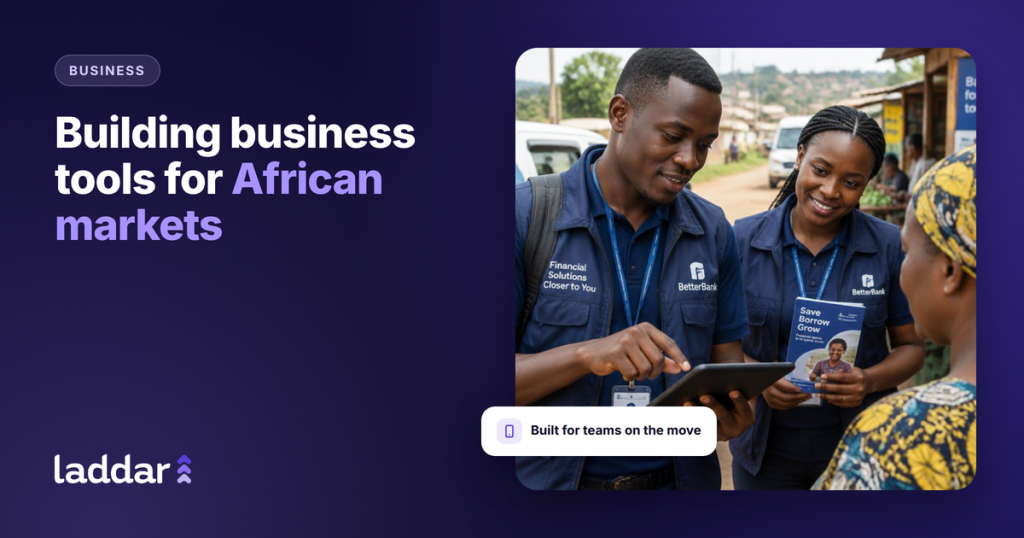
A typical growing business in Lagos, Nairobi or Accra may have a head office, a few regional managers and dozens or hundreds of people in the field. Sales reps visit retailers. Promoters run activations. Data collectors survey households. Agents onboard customers and verify addresses.
These teams are not occasional users of software. They are the business. If the tools they use are slow, confusing or built for a desktop, the data that reaches managers will be late, incomplete or unreliable.
What business tools for Africa need to get right
They must work on the phone first. For field teams, the phone is the office. Forms, check-ins, orders and photos need to be fast to complete on a mid-range Android device.
They must handle weak connectivity. Network coverage varies from street to street. Good tools let people keep working offline and sync when a connection returns, so no visit or sale is lost.
They must reflect local ways of selling and paying. Businesses sell in Naira, Cedis and Shillings. Customers pay by transfer, cash, POS and mobile money. Software that assumes card payments and dollar pricing creates friction from day one.
They must connect people, locations and data. A sale means more when you know who made it, where, at what time and against which target. Tools that keep people, places and activity in separate systems leave managers stitching the picture together by hand.
They must be simple to adopt. Many field teams are large and change often. If onboarding a new agent takes days of training, the tool will slow the business down instead of speeding it up.
The cost of tools that do not fit
When software does not match how teams work, people find their own way around it. Reports get typed up at the end of the week. Photos sit in personal galleries. Customer details live in individual phones. Calls to customers come from personal numbers.
Each workaround makes sense on its own. Together, they mean leaders make decisions on stale information, good performers are hard to spot, and customer relationships walk out of the door when people leave.
Building around how teams actually work
This is the thinking behind Laddar. Instead of asking African businesses to adapt to tools built elsewhere, Laddar starts from the realities of distributed teams: field execution, data collection, customer communication and workforce management, connected in one place.
- Field OS helps businesses plan, execute and measure field work across sales, activations, visits, attendance and data collection.
- Laddar Voice gives teams a modern calling system, with business lines, call routing and recordings that stay with the business.
- Laddar People helps businesses get vetted field agents ready to deploy, then onboard, manage and pay them.
The goal is simple: give every team, from the head office to the furthest field agent, tools that fit the way they already work, so that the information leaders need arrives clean, complete and on time.
The bottom line
African businesses do not need simplified versions of foreign software. They need tools designed for distributed teams, mobile work and local markets from the start. Businesses that choose tools built this way spend less time fighting their systems and more time growing.
Want to see how Laddar fits your operation? Send an email to getstarted@laddar.africa